Win the Presidency is for 3–4 players. Follow these five steps before anyone takes a turn. The whole setup takes about five minutes.
Step 1
Choose who starts first & game end criteria
The player whose birthday is closest to the Presidential Election Day goes first.
The default game end criteria is when the 36th state is won. On election night networks declare the victor when the 36th state (plus/minus a couple states) is called. Optionally you can choose a lower count criteria if you want to shorten the game.
Step 2
Draw home states
Separate the Home State deck — all states with 8–18 electoral votes. Shuffle it. Starting with Player 1 and going clockwise, each player draws 4 cards and keeps 1 as their home state. Discard the 3 unchosen cards face-down back into the deck and reshuffle before the next player draws.
| Home state deck — 21 states (8–18 EV) | EV |
|---|---|
| Alabama, Colorado, Indiana, Kentucky, Louisiana, Maryland, Massachusetts | 8–11 |
| Michigan, Minnesota, Missouri, New Jersey, North Carolina, Ohio, Oregon | 10–17 |
| South Carolina, Tennessee, Virginia, Washington, Wisconsin, Georgia, Arizona | 9–16 |
Step 3
Choose swing states
Using the same process as home state selection, each player in turn also selects swing states, 4 in total. If there are three players, player 3 picks both the 3rd and 4th swing state.
Step 4
Deal starting dollar hands
The dollar deck has 49 cards totaling $650M. Remove the $30M, $40M, and $50M cards and set them aside. Shuffle the remaining sub-$30M cards (43 cards) and deal 5 face-down to each player as their starting campaign fund. Shuffle the high-denomination cards back into the deck and place it in the center as the bank draw pile.
| Denomination | Qty in deck | Role |
|---|---|---|
| $2.5M | ×6 | Exact raises & making change |
| $5M | ×10 | Workhorse bids |
| $10M | ×12 | Workhorse bids |
| $15M | ×8 | Workhorse bids |
| $20M | ×6 | Mid-tier / contested states |
| $25M | ×3 | Mid-tier / contested states |
| $30M, $40M, $50M | ×2 / ×1 / ×1 | Whales — held out of the opening deal |
Step 5
Deal campaign cards
The Campaign Deck has 39 cards. Deal 1 card to each player from the 29 Action cards only (Debate, Open State, October Surprise, Recount, Veto). Shuffle everything else — including all 4 Super Tuesday cards and all 6 Economy (Instant Cash) cards — into one face-down draw deck in the center.
- October Surprise ×6 — trigger a standard auction for any non-swing state owned by an opponent (not their home state). Winner pays the current owner.
- Recount ×3 — trigger a new auction for any opponent-owned state, including swing states. Winner pays the current owner.
- Debate ×8 — all players compete in a trivia bracket for one unclaimed state.
- Open State ×8 — put any unclaimed state up for auction immediately. You choose which.
- Veto ×4 — cancel an October Surprise or Recount targeting one of your states.
- Super Tuesday ×4 — blind auction for 3 mystery states. Shuffled into the draw deck, not dealt at start.
- Economy (Instant Cash) ×6 — Devon Tusk ×2 and VP Gaffe ×4 resolve the moment they are drawn.
You're ready to play
Here's the full board you'll be campaigning across — every state shows its abbreviation, electoral votes, and a symbol unique to that state.
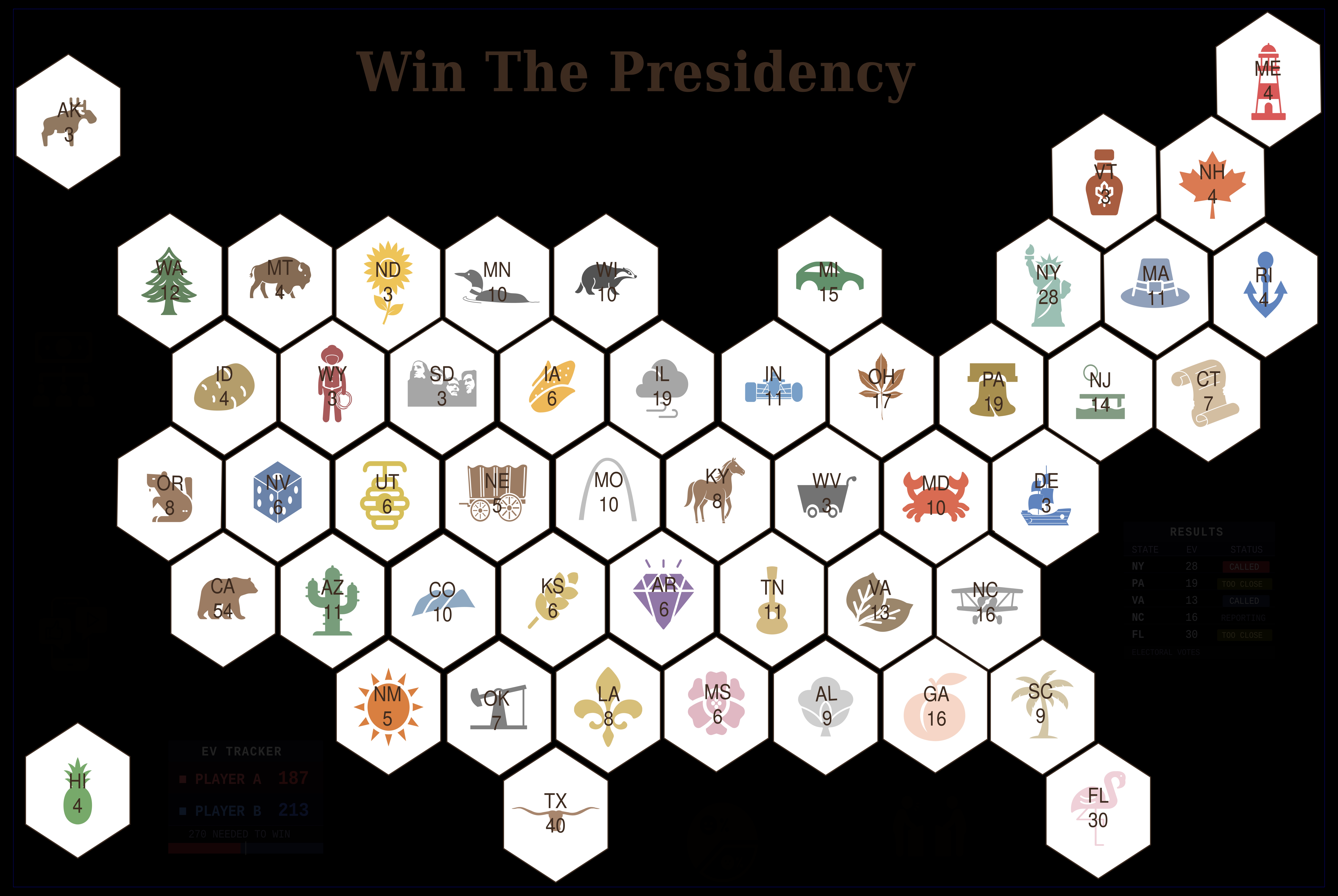
On each turn you may first play up to one Action card, then take exactly one main action: move your pawn 1–2 spaces to an unclaimed state and trigger an auction there, take a campaign card, or take two cash cards.
Minimum opening bid $5M · Raise increments $2.5M
Trivia: Easy +$5M / Hard +$15M bidding credit · 30-second window
Adjacency bonus: +$5M per adjacent owned state, max $15M, bidding credit only
Game ends when the 36th state is won — score immediately